
The Pollutants to Products (P2P) project was one of the most notable applied research initiatives to emerge from northwestern Alberta. Developed at Grande Prairie Regional College (GPRC, now Northwestern Polytechnic), P2P investigated methods for converting industrial pollutants and byproducts from oil and gas operations into commercially viable materials. The project embodied a fundamental shift in thinking: waste is not an endpoint, but a potential input for new value chains.
GPRC Alberta served as the academic anchor for this work, providing laboratory capacity, technical expertise, and student researchers. The college’s applied research infrastructure made it possible to conduct rigorous testing that would typically require a much larger university setting.
Did You Know: Northwestern Polytechnic (formerly GPRC) also hosts the National Bee Diagnostic Centre – one of only a handful of specialized bee health laboratories in Canada, supporting the $600-million Canadian honey industry.
The Problem: Industrial Waste in Energy Production
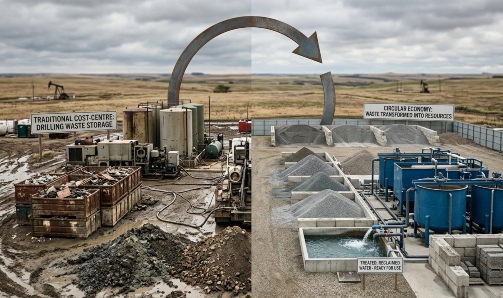
Oil and gas extraction generates substantial volumes of byproduct materials. Produced water, drilling cuttings, and process residues have traditionally been managed as cost centres – requiring disposal, treatment, or environmental remediation. The P2P project reframed this challenge by asking: can these materials be processed into something useful?
This circular-economy approach has gained significant traction globally. The Ellen MacArthur Foundation estimates that circular economy strategies could generate $4.5 trillion in economic value by 2030. The P2P project was an early regional example of applying these principles to the energy sector.
Research Methodology and Approach
Research Phase | Activities | Key Outputs |
|---|---|---|
Phase 1: Characterization | Chemical and physical analysis of waste streams from oil and gas operations | Compositional database of byproduct materials with commercial potential |
Phase 2: Processing Trials | Laboratory-scale conversion experiments testing multiple processing methods | Validated methods for transforming specific waste categories into usable materials |
Phase 3: Feasibility Assessment | Economic analysis, scale-up modeling, and industry consultation | Business case framework for commercial-scale waste conversion operations |
Collaboration with industry partners was essential at every stage. Energy companies provided waste stream access, shared operational data, and offered practical insights into the logistics of any eventual commercial implementation.
The Innovation Ecosystem Behind P2P
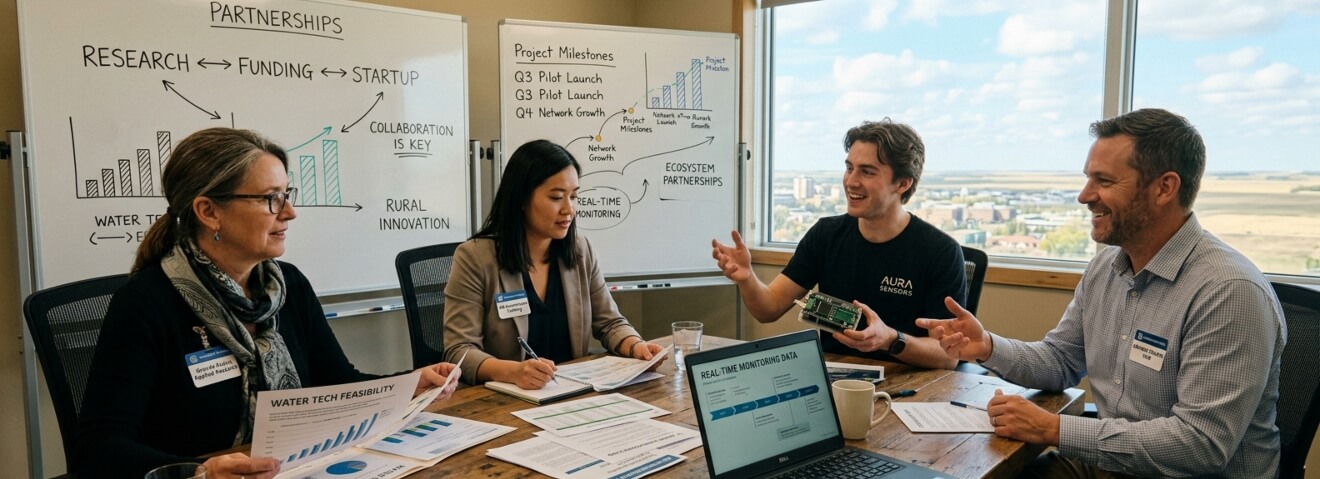
No research project succeeds in isolation. P2P benefited from a support ecosystem that included Alberta Innovates, the National Research Council’s Industrial Research Assistance Program (NRC IRAP), and the regional innovation network that operated in the Grande Prairie area. This ecosystem provided funding, mentorship, and connections to potential commercialization partners.
“We have become a very cohesive force in the ecosystem for really moving forward rural and early-stage innovation.”
– Jane Hunter-Uhryn, Manager, Innovate Northwest, Digital Journal, 2025
Results and Industry Impact
The P2P initiative produced several significant findings. Certain categories of industrial byproducts demonstrated strong potential for conversion into marketable materials. The project proved that processing methods developed at laboratory scale could be adapted for larger operations. Most importantly, P2P established a replicable template for academic-industry partnerships in applied research.
Key Takeaways from the P2P Project
First, environmental challenges and economic opportunities are not mutually exclusive – the same waste stream that creates a disposal cost can become a revenue source with the right technology. Second, academic institutions in smaller communities can produce commercially relevant research when supported by adequate funding and industry partnerships. Third, the path from laboratory to market requires an ecosystem of partners, funders, and advisors – a lesson that applies equally to any innovation venture, whether in energy, agriculture, or digital technology.
GPRC Alberta: An Applied Research Powerhouse
The GPRC story extends well beyond P2P. The institution (now Northwestern Polytechnic) has built a portfolio of applied research across agriculture, environmental science, and technology. Its transition to polytechnic status reflects a growing recognition that applied, industry-focused research institutions fill a critical gap in Canada’s innovation landscape – particularly in communities where a major research university is not present.
GPRC / NWP Research Area | Notable Project or Facility | Industry Relevance |
|---|---|---|
Bee Health & Agriculture | National Bee Diagnostic Centre | Supports Canadian apiculture industry valued at $600M+ |
Industrial Waste Conversion | Pollutants to Products (P2P) | Circular economy solutions for oil & gas operators |
Environmental Monitoring | Multiple applied research partnerships | Air quality, water management, emissions reduction |
Entrepreneurship Education | Side Family Centre for Entrepreneurial Excellence ($6.4M) | Hands-on startup training for regional entrepreneurs |