
The oil and gas industry operates under constant dual pressure: deliver energy affordably while reducing environmental impact. This tension has made the sector one of the most active arenas for applied innovation globally. According to the International Energy Agency (IEA), the oil and gas industry spent over $20 billion on clean energy technologies in 2023 alone – a figure that, while still small relative to total capital expenditure, represents a rapidly growing commitment.
In western Canada, innovation is not an abstract concept. It is a competitive necessity. Companies operating in the Montney and Duvernay formations of Alberta and British Columbia face complex reservoir conditions that demand advanced engineering solutions. The operators who innovate most effectively gain measurable advantages in cost per barrel, production efficiency, and environmental compliance.
Petroleum Engineering Innovations
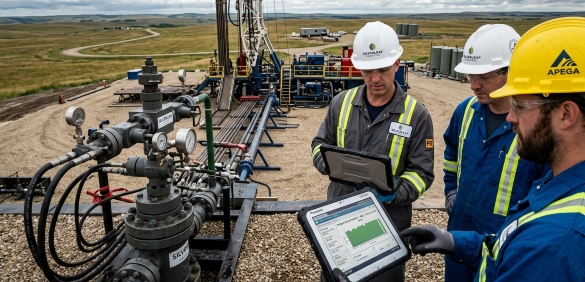
Petroleum engineering has undergone a dramatic transformation over the past two decades. Technologies that were experimental in the early 2000s are now industry standard.
Innovation | Impact | Adoption Level |
|---|---|---|
Horizontal Drilling + Multi-Stage Frac | Unlocked tight oil and shale gas resources globally | Widespread (standard practice) |
Real-Time Downhole Analytics | Guides drill-bit direction using live sensor data | Growing (most new wells) |
Intelligent Well Completions | Enables remote flow control across multiple zones | Moderate (complex wells) |
Enhanced Oil Recovery (EOR) | Increases recovery from mature reservoirs by 10-30% | Selective (mature basins) |
Computational Fluid Dynamics (CFD) | Optimizes equipment design, reduces failure rates | Growing (engineering firms) |
Brent Rheaume, founder of Rheaume Engineering in Grande Prairie, built an entire product line using computational fluid dynamics (CFD). His Sandtinel sand separator used CFD modeling – developed in collaboration with Dr. Carlos Lange at the University of Alberta – to outperform traditional sand separation technology. The company later applied the same CFD expertise to create Pipewise, a pipeline leak detection system.
“I wouldn’t be where I’m at without the help and support of Bob and Alberta Innovates. I’d still be struggling without the financial and networking support.” – Brent Rheaume, CEO, Rheaume Engineering, Alberta Innovates, 2023
Digital Transformation in Energy
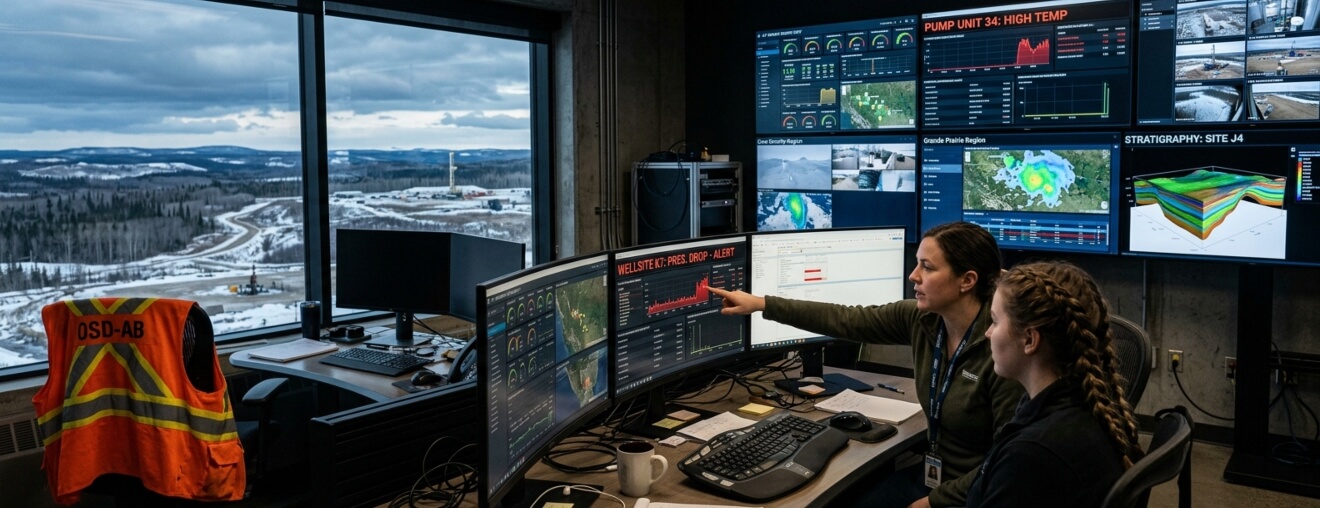
IoT sensors, machine learning, and cloud platforms are transforming oil and gas operations at every level. Remote monitoring reduces the need for on-site personnel in far-flung locations across northern Alberta. Predictive maintenance algorithms identify equipment failures before they occur, reducing costly downtime. Geological data analysis powered by machine learning improves exploration success rates.
In the Grande Prairie area, where field operations often span vast distances across the County of Grande Prairie and the Municipal District of Greenview, digital technologies are particularly valuable. Operators can manage dozens of remote sites from centralized control rooms, improving both safety and efficiency.
Environmental Innovation: From Liability to Opportunity
Environmental technology represents the most significant growth area in oil and gas innovation. Carbon capture, utilization, and storage (CCUS) is advancing from pilot stage to commercial scale in Alberta. Methane detection programs using aerial surveys and continuous monitoring are dramatically reducing fugitive emissions. Water recycling systems are cutting freshwater consumption in hydraulic fracturing operations.
The Pollutants to Products (P2P) project at Northwestern Polytechnic (formerly GPRC) demonstrated a different dimension of environmental innovation: converting waste streams into marketable materials. This circular-economy thinking is increasingly adopted across the energy sector.
■ Alberta CCUS Fact: Alberta’s Quest CCS project has stored over 8 million tonnes of CO2 since 2015, making it one of the largest operational carbon storage facilities in the world (Alberta Government).
Innovation Ecosystems for the Energy Sector
Successful oil and gas innovation requires collaboration among operators, service companies, technology startups, research institutions, and government agencies. Alberta’s ecosystem includes Alberta Innovates (annual budget $252.4 million), NRC IRAP, regional innovation networks like the one formerly operated in Grande Prairie as GPRIN (now Innovate Northwest), and academic institutions including Northwestern Polytechnic, the University of Alberta, and the University of Calgary.
“A lot of innovators have the ideas, and they’re maybe not quite sure how to get that idea to the production line.” – Tom Pura, GPRIN Committee Member, My Grande Prairie Now, 2024
Rheaume Engineering: A Grande Prairie Innovation Story
Rheaume Engineering offers a textbook case of how innovation works in the oil and gas sector. Founded in 2005 as a one-person consulting operation by Brent Rheaume, the company has grown into a 45-person full-suite engineering, procurement, and construction management (EPCM) firm with offices in Grande Prairie and Calgary. Along the way, Rheaume spun out two technology companies: RADIX Innovation Corporation (which developed Sandtinel) and Pipewise Technology, a pipeline leak detection system.
Rheaume Timeline | Milestone |
|---|---|
2005 | Brent Rheaume starts as independent contractor in Grande Prairie |
~2010 | Rheaume Engineering incorporates, hires first employee |
~2013 | RADIX Innovation develops Sandtinel sand separator with U of A partnership |
~2015 | CFD expertise applied to create Pipewise leak detection technology |
2020s | Expands to 45-person EPCM firm, opens Calgary office |
2025 | Celebrates 20 years in operation; full-suite energy engineering firm |
The innovation support ecosystem played a critical role. Alberta Innovates’ R&D Associates program funded a graduate student from Dr. Carlos Lange’s lab at the University of Alberta to work on CFD optimization for Sandtinel. NRC IRAP provided advisory services and funding. The Grande Prairie Regional Innovation Network (GPRIN) offered local networking and business connections.